





Solar Cycle 25 began in December 2019, as confirmed by scientists at NASA and NOAA. Solar cycles typically last about 11 years, meaning Solar Cycle 25 will likely continue until around 2030–2031. The cycle’s peak activity, marked by the highest number of sunspots, occurred (or is expected to occur) around 2024–2025.
Here is all you need to know to get the best of the sun power!
1. THE EARTH’S ATMOSPHERE
Before studying the propagation of radio waves, we need to have a clear understanding of the Earth’s atmosphere.
Air is composed of nitrogen, oxygen, hydrogen, and some other gases. The highest air density is located near the Earth’s surface, where air acts as a good dielectric. At higher altitudes, the density decreases, and the air becomes much thinner. The atmospheric limit, however, is situated at very high altitudes, reaching up to 1,000 kilometers or more.
In the troposphere, which is the lower layer of the atmosphere and extends up to 10 to 14 kilometers above the Earth’s surface, all gases are well mixed; its air composition remains practically constant. However, at greater altitudes (hundreds of kilometers above the Earth’s surface), the air becomes much rarer, and gases are distributed in superimposed layers. The relative position of each layer is determined by the weight of the gas. Therefore, at high altitudes, the composition of the atmosphere is not homogeneous.
Air becomes ionized (i.e., certain atoms of the gases composing the air are “broken” into free electrons and positive ions) by solar radiation, cosmic rays, and other factors. Ionized air strongly influences the propagation of radio waves.
The most pronounced ionization of the various gases occurs at different altitudes because the various gas layers prevail at different heights. In practice, it has been found that the ionized part of the atmosphere, the ionosphere, is divided into several layers, as shown in Figure 1.
The D layer, which exists only during the day, is located at an altitude of 60 to 80 kilometers; the E layer is between 90 to 130 kilometers; the F layer is between 250 and 350 kilometers at night. An interesting feature of the F layer is that it divides, during the day, into two layers: F1, situated at an altitude between 180 and 220 kilometers, and F2 between 220 and 500 kilometers.
Clearly, there are no precise boundaries between these layers and other parts of the atmosphere. The altitude, thickness, and conductivity of the ionized layers vary throughout the day and year due to changes in the ionizing activity of solar rays. The properties of the ionosphere, however, also change from year to year in an 11-year cycle, which is also attributed to solar activity. The greater the sun’s ionization intensity, the higher the conductivity and thickness of the ionized layers, while their altitude decreases. During the day, their conductivity and thickness are higher, and their altitude is lower compared to nighttime. In summer, their conductivity and thickness are also higher, and their altitude is lower compared to winter.
Every 11 years, the solar cycle reaches a maximum of solar spots, which are powerful sources of ionized emissions. At that time, the conductivity and thickness of the ionized layers of the Earth’s atmosphere reach their maximum values, while their altitudes decrease. These complex laws govern the properties of the atmosphere, which, in turn, govern the propagation of radio waves. In addition to these periodic variations, there are also chaotic variations that cannot be predicted.
Magnetic storms, for example, which strongly affect radio reception, sometimes last for hours or even days. These magnetic storms are caused by powerful eruptions of electrons from the sun; these electrons reach the Earth’s atmosphere and strongly influence the ionized layers. The F2 layer is particularly affected by these phenomena; its conductivity decreases, its altitude increases, and the layer divides into clouds of electrons or dissolves completely.
When meteors enter the atmosphere at the height of the E layer (around 100 kilometers), the so-called “sporadic E layer” may appear, characterized by very strong ionization that does not extend beyond a thousand kilometers and only exists for a few hours.
Alongside all these phenomena, chaotic fluctuations continuously occur in the atmosphere, which are more intense in the upper layers, especially in the F2 layer.
All these aforementioned changes, which constantly occur in the ionosphere, interfere with the normal propagation of radio waves and sometimes completely hinder radiocommunication. This complicates the understanding of propagation laws and the calculation of communication systems based on these laws.
Let us now analyze various phenomena observed in the propagation of radio waves.

Figure 1 – The ionized layers into which the ionosphere is divided.
2.1 — Dissipation of Radio Wave Energy
When a radio wave leaves a transmitter’s antenna and begins traveling in all directions, the wave energy is distributed in an ever-expanding space. Consequently, the amount of wave energy at each point in space constantly decreases. Directional transmission is the only way to reduce the effect of dissipation. In this type of transmission, the radio wave is sent as a narrow beam toward a desired region. This increases the communication range of a radio station and can be used for certain secret communications, as only receivers within the beam path can pick up the signal. Directional transmission is also used by radio beacons, which are important for aviation and maritime navigation.
2.2 — Absorption of Radio Waves
The energy of radio waves passing through various substances is absorbed by those substances. Only in interplanetary space does absorption not occur, making it possible to use low-power transmitters for interplanetary communications. Non-ionized air absorbs very little energy from radio waves. A significant portion of the energy is absorbed by solid dielectrics, semiconductors, and conductors.
When a radio wave encounters a conductor, the conductor absorbs most of the wave energy. This happens due to the movement of electrons induced in the conductor, creating a high-frequency current that requires energy, which the conductor absorbs from the radio wave. This phenomenon forms the basis of radio reception. However, if the wave travels parallel to the conductor, much less energy is absorbed. This is why radio waves propagate over longer distances when they travel along conductive surfaces like the sea, rivers, railway tracks, and transmission lines. Propagation distance is considerably shortened when the wave travels over poorly conductive surfaces, such as dry land.
As mentioned earlier, dielectrics also absorb wave energy. The ionized layers of the atmosphere, being semiconductors, absorb a significant portion of the wave energy. As radio waves travel along the Earth’s surface, their energy is absorbed by the ground, objects, and obstructions such as mountains, forests, and power transmission lines.

2.3 — Reflection and Refraction of Radio Waves
In a homogeneous medium, radio waves travel in straight lines, but when a wave transitions from one medium to another, reflection and refraction occur. These phenomena happen at the boundary between two media with dielectric constants E1E_1E1 and E2E_2E2.
When a wave strikes the boundary between two media, it reflects at a certain angle, causing reflection (Figure 2). A wave striking a smooth surface at a right angle reflects at the same angle, essentially retracing its path. If a beam of parallel waves hits a smooth surface, the reflected beam remains parallel. However, if the surface is not smooth, the reflected waves will diverge. Conductors are the best reflectors of radio waves.
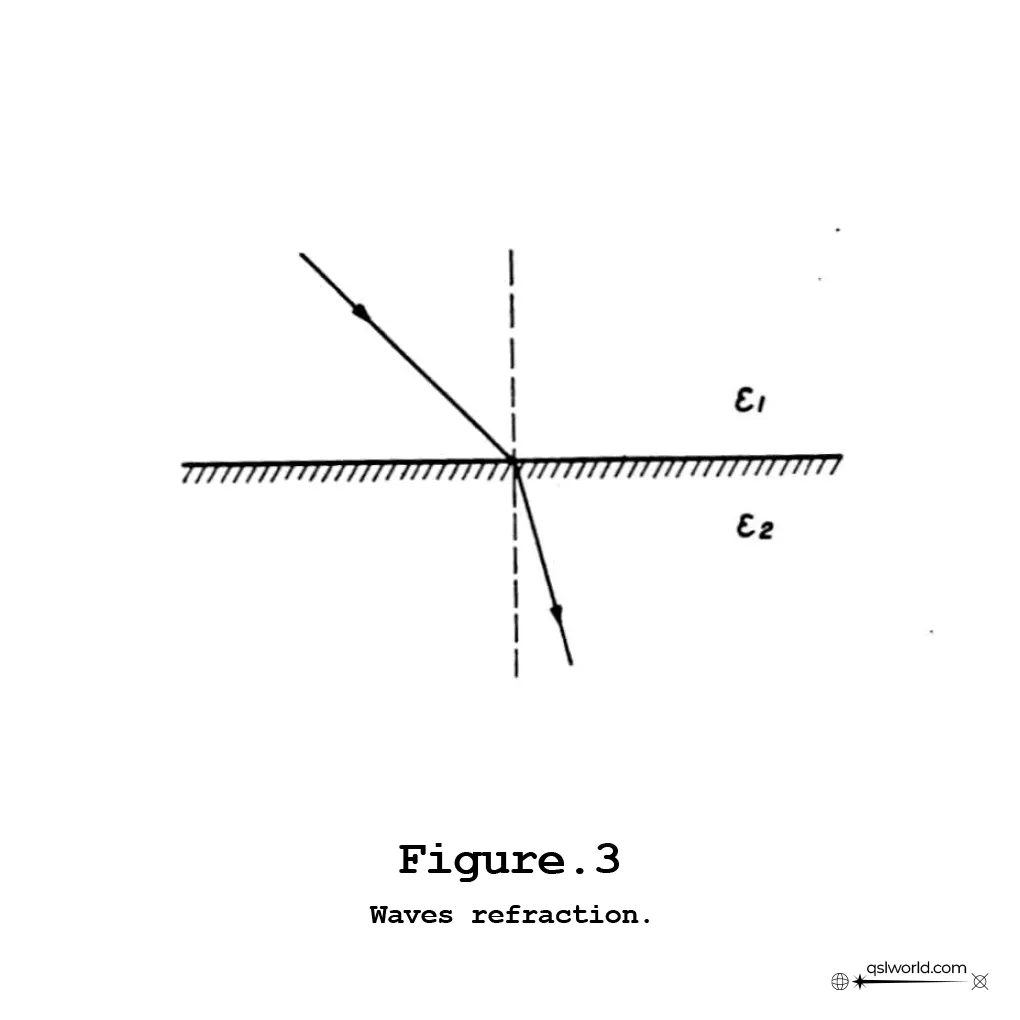
When a radio wave passes from one dielectric to another, it changes direction, resulting in refraction (Figure 3). The greater the difference between the dielectric constants E1E_1E1 and E2E_2E2 and the longer the wavelength, the more pronounced the refraction. Refraction occurs due to the varying speeds at which waves pass through different substances.
Therefore, a radio wave striking a conductor is partially absorbed and reflected. If it strikes a dielectric or a semiconductor, it is absorbed, reflected, and refracted.
2.4 — Diffraction of Radio Waves
When a radio wave encounters an obstacle such as a mountain or a large building, the wave can bend around the obstacle and reach the other side. This phenomenon is known as diffraction (Figure 4). The longer the wavelength, the greater its ability to bend around obstacles. Evidently, a wave cannot sharply curve, which is why “dead zones” exist behind mountains and metallic structures. In these zones, certain stations cannot be received, but reception is restored further away due to diffraction.
Now that we understand the various phenomena affecting radio waves, we can analyze how these waves propagate through the Earth’s atmosphere.

3. PROPAGATION OF WAVES
Radio waves that are emitted horizontally and propagate along the Earth’s surface in the lower layer of the atmosphere are called ground waves. As these waves travel along the ground, they are absorbed by the Earth and various local objects. The higher the wave frequency, the greater the absorption. Depending on the frequency, ground waves follow the curvature of the Earth more or less easily due to diffraction.
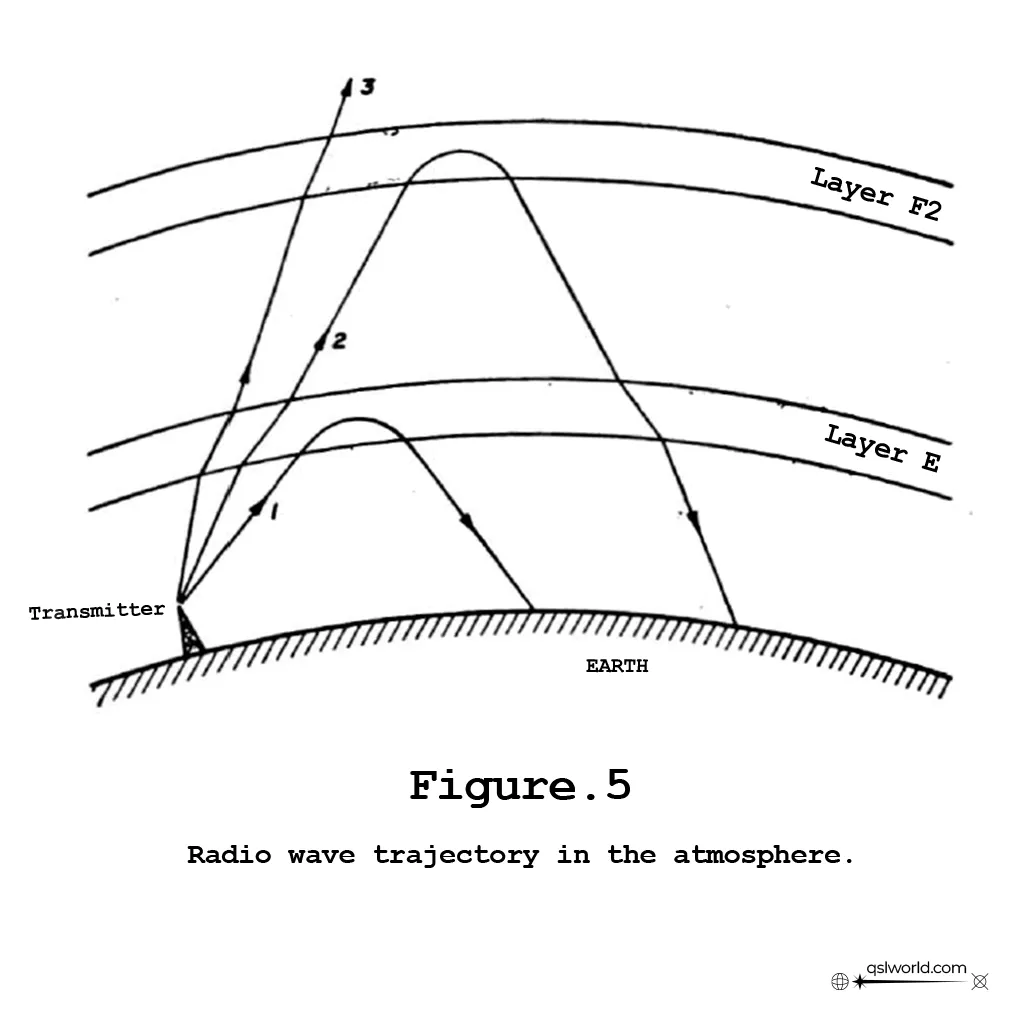
Radio waves emitted at an angle to the Earth’s surface are called sky waves. These waves pass through the lightly ionized parts of the atmosphere and reach the ionosphere, where they are refracted. As both the ionization and the dielectric constant (EEE) gradually change in the ionospheric layers, the wave’s path takes on a smooth curve. The longer the wave and the stronger the ionization, the more pronounced the curve of the wave.
Figure 5 illustrates the E and F2 layers at night. Path 1 corresponds to a short wave with a relatively low frequency, which is strongly refracted in the E layer and returns to Earth. This wave is said to be reflected by the E layer. Paths 2 and 3, which correspond to shorter waves, pass through the E layer because its degree of ionization is insufficient to make the waves return. The ionization of the F2 layer is also insufficient to return wave 3 to Earth. Two factors could explain this: either wave 3 has a frequency that is too high, or it enters the E layer almost perpendicularly and is not deflected enough to return to Earth. This wave will eventually reach interplanetary space.
Wave 2, however, reaches Earth at a point further from the transmitter than wave 1.
Waves are not only refracted in the ionized layers but are also absorbed there. The greater the wavelength, the greater the absorption. Since the altitude and ionization intensity of the layers change, the paths of sky waves also change correspondingly. This explains the considerable variation in shortwave signal intensity throughout the day and year. It also explains the phenomenon known as “fading.”
3.1 — Long Waves
Long waves, with wavelengths between 3 and 30 km, are not used for broadcasting in Brazil. Ground waves follow the Earth’s curvature, enabled by their strong diffraction ability. However, the Earth and obstacles absorb much of their energy.
Sky waves of this wavelength are reflected by the ionosphere (during the day by the D layer and at night by the E layer). These waves return to Earth, are reflected by it, and continue this cycle repeatedly. During these repeated reflections, significant absorption occurs, which is why long-wave transmitters require high power for long-distance communication.
Long wave communication does not experience fading. During winter and nighttime, reception is slightly better than in summer and daytime because the air is less ionized, reducing absorption. Other changes in the ionosphere and troposphere have little impact on long wave propagation. Compared to other wavebands, long waves provide the most consistent propagation conditions.
3.2 — Medium Waves
Medium waves are universally used for broadcasting. Their wavelengths range from 200 to 600 meters, or 1500 to 500 KHz. Sky waves in this band are strongly absorbed by the ionosphere during the day, making them of little practical use for radio communication.
Ground waves in this band are also strongly absorbed by the Earth. The shorter the wave and the poorer the conductivity of the surface layer, the greater the absorption. Communication over the sea experiences the least absorption, while dry land has the highest absorption.
As a result, medium waves propagate over shorter distances during the day than at night. At night, the ionospheric absorption is significantly lower, enabling better propagation. Because of this improved nighttime propagation, broadcasting stations reduce their transmission power at night to avoid interference with other stations operating on nearby or identical frequencies.
The range of medium wave communication is also greater in winter due to reduced ionospheric absorption.
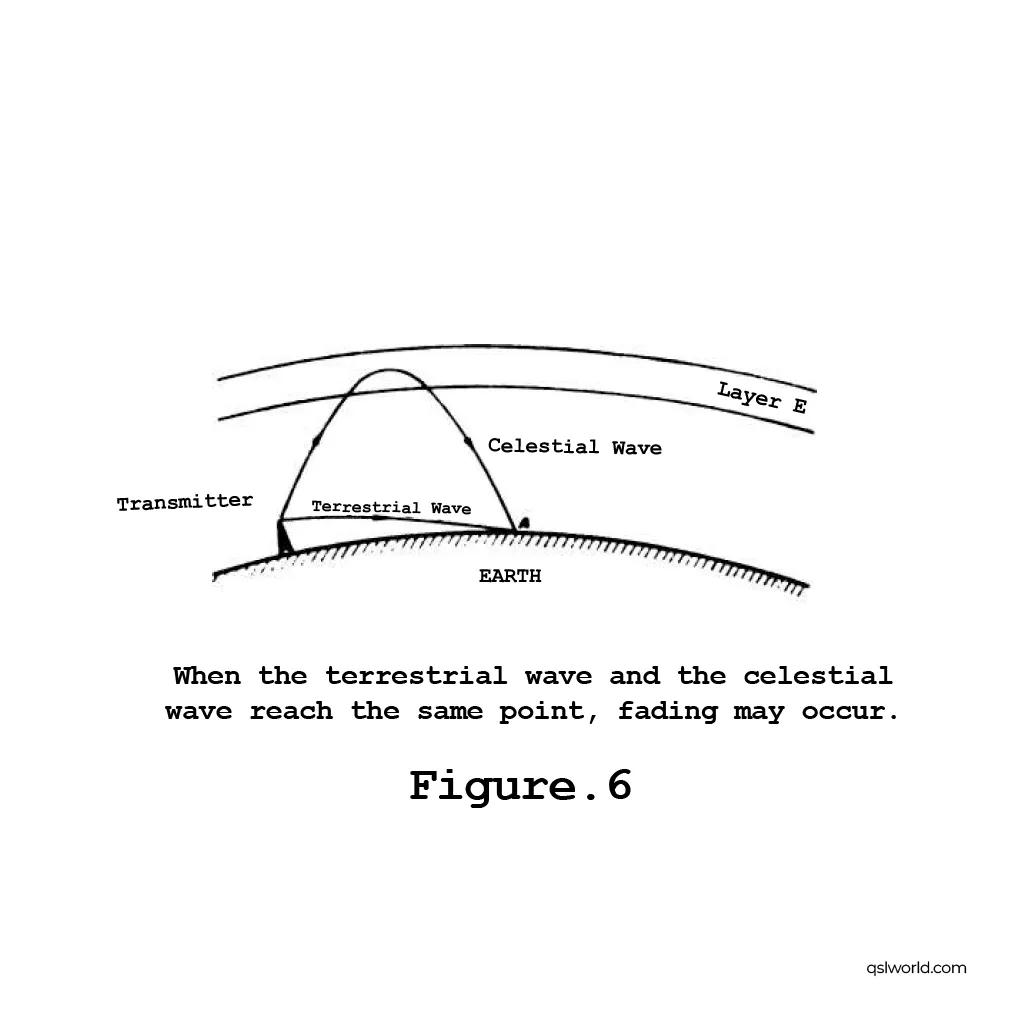
At night, medium wave reception often exhibits considerable fading. This occurs due to the interaction of ground and sky waves, which follow different paths and reach the receiving antennas out of phase. Other ionospheric changes have minimal influence on medium wave propagation. However, strong atmospheric interference caused by lightning strikes in the atmosphere, particularly intense during the summer, can disrupt medium wave reception.
3.3 — Intermediate and Short Waves
Waves in this range, with wavelengths from 10 to 200 meters (30 to 1.5 MHz), are strongly absorbed by the Earth. As a result, the range of ground waves is limited to just a few tens of kilometers. The lower the energy and the shorter the wavelength, the shorter this range.
Beyond this range lies the “silent zone,” shown in Figure 7. Depending on the wavelength, time of day, and season, this silent zone can extend from several hundred to several thousand kilometers.
After the silent zone begins the audible zone. Signals reach this zone through one or more reflections in the ionosphere. Reception is typically good, though it almost always experiences fading, which can be both intense and frequent.
The silent zone virtually disappears for waves between 80 and 200 meters, but it appears at night for waves between 50 and 80 meters. Waves from 35 to 70 meters are primarily used for long-distance nighttime communication and for short distances (ground wave communication) during the day.
Waves from 10 to 25 meters are minimally absorbed by the E layer, making them ideal for daytime communications. However, these waves have a much larger silent zone, especially at night. These shorter waves are not ideal for nighttime communication because the F2 layer’s ionization at night is insufficient to return them to Earth.
For long-distance operations, waves from 25 to 35 meters are used, both day and night. Broadcasting stations primarily use waves between 10 and 35 meters during the day and switch to waves between 25 and 70 meters at night.
The primary advantage of short waves is the ability to communicate over thousands of kilometers using transmitters with power outputs as low as a few watts.
Various disturbances, such as magnetic storms in the ionosphere, can significantly affect short wave propagation and sometimes make radio communication on these waves entirely impossible.
Short waves are more resistant to interference than other waves. The shorter the wave, the greater its immunity to interference.

3.4 — Metric, Decimetric, and Centimetric Waves
Waves shorter than 10 meters are not significantly reflected by the ionosphere and instead penetrate into interplanetary space. These waves can then be reflected by the Moon or Venus and picked up again on Earth. For radio communication, only ground waves are used in these very high frequencies.
These waves are strongly absorbed by various objects and, moreover, undergo little diffraction. As a result, there must be no obstacles in the line of sight between the transmitting and receiving antennas operating on these waves. If the distance is such that the Earth’s curvature becomes a factor (several tens of kilometers), the antennas must be positioned at significant heights.
The main advantage of these waves is the low level of fading and the fact that their propagation does not depend on the time of day or season. This is easily understood, as their propagation is not influenced by the ionosphere.
These waves also offer other advantages, such as ease of directional transmission and near-total absence of interference.
Instances of ultra-high frequency wave reception at distances of several hundred or even thousands of kilometers from the transmitting station are known. Such reception is typically irregular and accompanied by fading.
There are several reasons for these anomalous contacts at ultra-high frequencies:
Solar Activity Peaks: During periods of maximum solar activity, the ionosphere occasionally reflects waves of 6 to 7 meters during the day.
Electron Clouds: The formation of electron clouds (sporadic and short-lived highly ionized layers in the ionosphere) results in the reflection of waves as short as 3 meters.
Meteor Trails: Meteors entering the Earth’s atmosphere create ionized paths in their wake.
Tropospheric Temperature and Humidity Changes: These changes can intensify atmospheric refraction of ultra-high frequency waves in some cases. This allows these waves to propagate through multiple reflections between a tropospheric layer and the Earth’s surface.
Irregularities in the Troposphere: Sometimes, these waves are reflected due to specific irregularities in the troposphere at various altitudes.
Summary of this blog post
The text covers the atmosphere’s composition, behavior, and its impact on radio wave propagation, detailing how various phenomena influence communication over different frequency ranges.
1. Earth’s Atmosphere
The atmosphere is composed of gases like nitrogen, oxygen, and hydrogen, with the densest layers near the Earth’s surface. At higher altitudes, air becomes rarefied and ionized due to solar and cosmic radiation. This ionized air forms the ionosphere, which is divided into layers (D, E, F1, and F2) depending on altitude and time of day.
Key factors include:
Ionization levels
fluctuate daily, seasonally, and over an 11-year solar cycle.- Magnetic storms and other chaotic variations disrupt radio communication.
2. Radio Wave Phenomena
Radio waves experience several effects as they interact with the Earth’s surface, atmosphere, and ionosphere:
Energy Dissipation: Wave energy spreads out as it travels, reducing its intensity. Directional transmission focuses energy and increases range.
Absorption: Energy is absorbed by solid and ionized substances, with better propagation over conductive surfaces (e.g., water) and poor performance over dry land.
Reflection and Refraction: Waves bounce off conductive surfaces and change direction when passing between mediums of different densities.
Diffraction: Waves bend around obstacles, like mountains, enabling signals to reach areas blocked by direct paths.
3. Propagation by Wave Types
Ground Waves: Follow the Earth’s surface but are limited by absorption.
Sky Waves: Reflected by the ionosphere, enabling long-distance communication. Their behavior depends on ionization levels and wave frequency.
4. Wave Bands and Their Characteristics
Long Waves (3–30 km): Stable propagation with minimal fading; used for navigation but requires high transmission power.
Medium Waves (200–600 m): Heavily absorbed during the day; better nighttime performance but susceptible to fading and atmospheric interference. Commonly used for broadcasting.
Short Waves (10–200 m): Ideal for long-distance communication; sensitive to ionospheric conditions but less prone to interference. Widely used for global communication.
Metric, Decimetric, and Centimetric Waves (<10 m): Not reflected by the ionosphere; rely on line-of-sight propagation and require high antenna placement. Minimal fading, less atmospheric impact, and used in applications like radar and satellite communication.
5. Anomalies and Special Conditions
- Solar activity, meteor trails, and tropospheric changes can cause unexpected propagation phenomena, such as long-range reception of ultra-high frequencies.
Summary Conclusion
The post provides a comprehensive overview of how the Earth’s atmospheric and ionospheric conditions govern the behavior of radio waves. It explains how factors like ionization, wave frequency, and surface properties affect wave propagation and outlines specific characteristics of different wavebands used in communication.